Showing posts with label Photos. Show all posts

Sunday, May 1, 2011

Happy Labor Day!

If you haven't looked at a calendar yet today, today is May 1st, which for China and many other countries is Labor Day, or in Chinese, 劳动节(láodòng jié). Since the holiday falls on a Sunday this year, Chinese people have tomorrow off too. (I don't have the day off however, since for scheduling purposes BNU decided to give us April 29th off instead of May 2nd)

For obvious reasons, the United States does not celebrate Labor Day on May 1st. (If you don't know why, do a quick internet search on "International Worker's Day.") But, since I'm in China, I hope you have a fantastic May 1st, regardless if May 1st has any significance (labor-related or otherwise) to you.

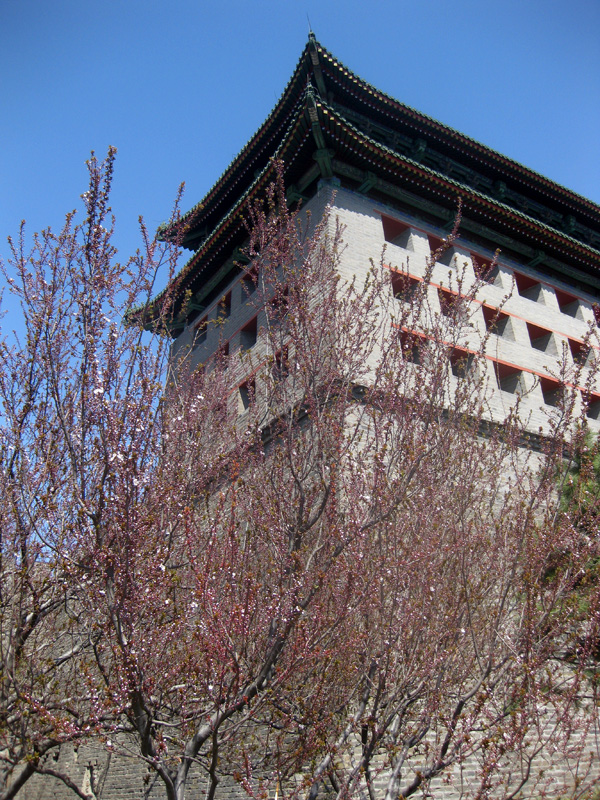
Now for some pictures I took almost a month ago at the Ming Dynasty City Wall Relics Park and Southeast Corner Watchtower.


Side note: I know, I know. I've been slacking on the blogging recently. My sincerest apologies. I know I still have a ton of pictures to go through from Hong Kong and posts to write about that. I blame the weather. It's impossible to stay inside when the weather's been so great these past few weeks. I guess it's probably a good thing I attended college in New York and not somewhere with a warm climate. Haha. On the upside though, it does mean I do have a lot of blogging material just waiting for me to write about. So stay tuned!

Saturday, April 2, 2011

Shikumen Houses

In case I gave you the wrong impression of Shanghai in my last post, Shanghai, despite being a very modern city, does have older parts as well. Aside from the instantly recognizable Bund, another characteristic of Shanghai's by-gone years are it's shikumen houses.

Shikumen houses are a specific style of housing built in the latter half of the 19th century in the foreign settlements to accommodate the influx of refugees from the neighboring Jiangsu and Zhejiang provinces. Literally translated, the term "shikumen" (石库门) means "stone gate," which refers to the stone gates and black doors that were the cornerstone of shikumen architecture.

From the exterior, many of the shikumen houses look very Western in the sense that many incorporate architectural elements more traditionally found in Western cities into the buildings, such as it's namesake stone gates, and verandas. However, behind the gates most of the homes are still laid out in a more traditionally Chinese style that revolves around the central courtyard. In some ways, this mix, at least in my opinion, is the perfect mix of the blended Western and Chinese cultural atheistic that is so very unique to Shanghai.

While we were in Shanghai, Leslie & I spent a decent amount of time wandering around the shikumen houses in the older part of Shanghai. Although the shikumen houses (like the hutongs in Beijing) are constantly under the threat of a wrecking ball, there are still some areas with shikumen houses left, which I strongly believe need to be preserved. While the shikumen houses may not be glamorous or stunning like the Bund, they are also a vital part of Shanghai's heritage that is worth preserving.

Now for some pictures:


For more information on Shanghai's shikumen houses:   http://www.shanghaiholiday.net/shikumen/

Friday, April 1, 2011

Shanghai, Take 2

Stop number three (number four for Leslie) on my winter break travel itinerary was Shanghai. Although I had been to Shanghai previously (see posts here and here), I was excited to return and explore it on my own more thoroughly.

Upon arriving in Shanghai and making our way over our hostel, it was immediately apparent that we were back in the big city. Instead of the more laid-back, quiet(er) pace of Qingdao and Hangzhou, in Shanghai we were immediately greeted with giant crowds, honking cars and a large rush of people going in all directions. I distinctly remember turning around and saying to Leslie "We're definitely back in the city now."

Though it's apparent immediately that Shanghai is a very metropolitan city, I think after spending several months in Beijing it's much more striking just how modern and cosmopolitan it actually is. In comparison, Beijing looks like the older, more worn-down sibling of the younger, more polished Shanghai. While the best phrases to describe Beijing probably are historical and politically significant, the words cosmopolitan and modern probably best describe Shanghai.

In some ways, the difference between Shanghai and Beijing almost remind me of New York and Washington, D.C. It's undeniable that politically, D.C. is a very important city. The decisions made in D.C. affect not only the people of the United States, but often the lives of many people outside of it's borders. That being said though, Washington, while it does have it's own local scene, does not have the cultural pull in the United States that New York does. Washington makes the laws, but arguably, New York is the cultural (not to mention financial) capital of the United States.

Likewise, in China, Beijing is undoubtedly the political and historical capital of the country. However, if you look at art and lifestyle trends, I'd say the majority of the taste-makers are centralized in Shanghai. Not to mention that like New York, Shanghai is also the financial capital of China. So while Beijing dictates the rules by which Chinese people abide by, Shanghai tells them how their lives should look, feel, hear, taste and probably even smell.

Of course with that being said, not all of Shanghai is the modern, glitzy city that most people think of right away when think of Shanghai. There are definitely old parts as well, but I'm leaving that for another post. So stay tuned.


More pictures on Angela Photo Musings

Wednesday, March 16, 2011

Ready, Set...Marry?? Part II

Marriage. I don't think I've given the topic of marriage much serious thought as I have this past year. Granted, this is perhaps at least in part due the fact that more and more people I know from high school and college are getting engaged/ married and the age gap between those I know who are engaged/married has become increasing smaller, or in some cases, non-existent.

Taikang Lu, Shanghai

Not to mention that I've recently celebrated another birthday (hello, 23) and while I'm still very young, I have to admit it doesn't sound nearly as young as when you say you're 20/21/22.

But mostly, I think the real reason why this subject has really pestering me lately is largely due to the environment around me. As I mentioned in the blog post before this, "Ready, Set..Marry?" China has quite the obsession with young people getting married, particularly before the age of 30.

Even in the classroom setting, this mentality has wormed itself into the curriculum. I remember last semester, the topic of marriage was often used in examples explaining grammatical structures and concepts. For instance, when explaining the term 连 (lián), which grammatically is used similarly to the word "even" or "already," our teacher used the example of "她连45岁没有结婚, " (tā lián 45 suì hái méi jiéhūn) which translates to "She is 45 years old and still hasn't married."

Another time, while trying to explain the grammatical usage of the word 才(cái), which is roughly used similarly to the word "finally" in English, our text book stated, "她35岁才结婚" (tā 35 suì cái jiéhūn.), which translates to "She finally married at 35 years old." Why the teachers and the textbooks couldn't come up with different examples using time or meals or anything else is beyond me.

Monday, March 7, 2011

Old Hangzhou

Near our fantastic hostel in Hangzhou, was an older portion of the city where many older locals still resided. As we meandered through the area, we actually found a small food market area where all the locals go daily to shop for fresh vegetables, fruit and other edible items for that's day meals.

Whenever I travel, I love to browse around the local food markets. Markets always are the best place to observe the local life, so I was happy that we found one by accident in Hangzhou.

The market that we ran into in Hangzhou was half indoors and half outdoors. At this market, you could find anything you might need to make a meal--vegetables, fruit, meat, dried goods, spices, fish and live poultry.

Yes, I said live poultry. Chinese people like to get their food as fresh as possible, meaning it's best if you actually met the chicken you're going to eat while it's still alive. Much of the fish being sold as well at the market was also still swimming.

For me, coming from my Chinese background seeing all the live poultry and fish didn't really bother me. After all, this is basically the way it's been done for years in China and in the US, my parents still prefer to buy live fish as opposed to frozen fish to cook.

But for Leslie, I think she might have been a bit startled to see just how much freshness really mattered to Chinese home cooks. She was also quite interested to see the vendors selling all the different soy products from tofu to bean curd sheets to dried tofu.What can I say? Tofu is really what cheese is like to the West. While cheese in the West comes in many shapes in sizes, in China, the tofu possibilities are seemingly endless.

Pictures from the older part of Hangzhou shall now commence forth, including one of (the woman we dubbed as) the tofu lady.


Tofu lady

More pictures on Angela Photo Musings.

Friday, February 25, 2011

Hangzhou, Re-visited

Stop number two on my winter break travels (stop number three for Leslie) was Hangzhou.

If you're unfamiliar with Hangzhou, it's a city roughly 190 km (about 118 miles) southwest of Shanghai. For many years, Hangzhou's famed West Lake (西湖) made it a popular vacationing spot. Just this year, the New York Times placed Hangzhou in the 33rd spot on their list of "The 41 Places to Go in 2011." It's also now the home to Baidu, China's answer to Google and many of China's other high-tech firms.

As the title of this post suggests, this was my second time to Hangzhou. The first time I was there was with my parents just this past September before my semester started here in Beijing. However, that first time was with a tour so I didn't really get any chance at all to explore on my own, so I was happy to return and get a chance to walk around on my own.

The first we noticed when we landed in Hangzhou (we flew down from Qingdao), was that there was snow on the ground!

Okay, so I realize that doesn't sound so shocking to many of you. But you have to understand that at this point, Beijing & most of the northern China hadn't seen any rain/precipitation since October, much less snow. So when we got to Hangzhou, which was noticeably warmer than Beijing and Qingdao (since it's farther south), we were a surprised to see snow on the ground, even though it wasn't very much.

After we got out of the airport and into the city, Leslie & I hailed a cab to go to our hostel. But since our hostel was in a pedestrian-only area, our taxi driver only drop us off at the gate of the pedestrian-only area.

Since we had directions from the hostel, Leslie & I were not too worried about not being able to find it, however before we could even figure out our bearings, a older man stopped to talk to us. At first, I thought he might be selling something, but after a split second, I realized he was giving directions to our hostel. After speaking to him for a moment though, he offered to show us where it was and no, he was not looking for a tip. He really was just being incredibly kind. Leslie & I were quite shocked by his hospitality.

As it turns out though, hospitality in Hangzhou was not just limited to this one person. Another time, Leslie & I had just pulled out our map to check where we were and another elderly man stopped and told us where we were before we even had a chance to glance at the map. And even one other time, we were walking down a pedestrian street near our hostel and an older woman stopped her conversation with another man just to talk to us & have me explain to Leslie a bit about Hangzhou's history. I have to say, the hospitality of the people in Hangzhou was quite frankly amazing and it made a really big impression on me. I already had a high opinion of Hangzhou to begin with, but the people's attitude to tourists made it even higher.

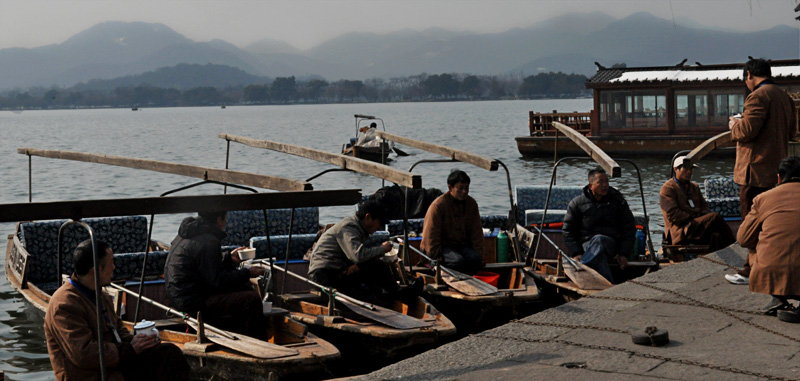
The next day, Leslie & I set out to explore the star of Hangzhou: West Lake. Since we got to Hangzhou with enough time to explore a bit the day before before sunset, we already had walked a bit around lake closest to our hostel, so in the morning we headed up in a vaguely sketchy looking van-bus up to the northern part to explore the other sections.

As we walked around the lake, I was really struck by how beautiful the lake really is. The first time, I think I was a bit jaded by all the previous lakes & Chinese gardens we had seen before Hangzhou so West Lake didn't seem that special to me at the time. However, cut to the a few months later after being in Beijing for a while, and the West Lake seemed magnificent in comparison to Beijing (no offense to Beijing).

Probably the most striking thing about the lake was that even though it was the dead of winter and many trees were missing there leaves, there was still a lot of greenery around. In comparison to Qingdao and Beijing, which both looked very grey and almost dead (in terms of plant-life), Hangzhou seemed incredibly green & lush, despite having snow on the ground. The contrast of the snow, the greenery, the bare branches and the occasional already-blooming flower was incredibly beautiful.

Okay, that's enough writing for now. I'll continue writing about Hangzhou in another post. I know all of you just really want to see the pictures so, without further adieu...


Lots more pictures on Angela Photo Musings.

Friday, February 18, 2011

Qingdao

The first stop on my winter break travels was Qingdao, which is located on the southern most tip of the Shandong peninsula in northeast China. Leslie & I took the overnight train from Beijing to Qingdao and stayed in a hostel near the center of the old town. We had booked ourselves into a shared four person dorm; however since it was low season, we ended up having the entire room to ourselves the entire time we were there.

Now for background on Qingdao:

From 1897 to 1922, Qingdao was a German and Japanese concession city and as a result, much of Qingdao's old architecture still retains a German flair. In 1919, protesters in Qingdao headed the May 4th Movement against imperialism in China, with particular regards to the Japanese presence in Qingdao after the end of WWI. More recently, Qingdao hosted the sailing portion of the 2008 Olympics in Beijing and it remains a popular summertime destination because of it's many beaches.

Some thoughts on my time in Qingdao:

  • Qingdao is definitely a summertime city. Many things when Leslie & I were there were closed. Some of them might have been closed down early in anticipation of the Spring Festival/Chinese New Year, but I suspect some of them only do business during the summer catering to tourists. Plus, many of Qingdao's attractions revolve around the beach, which isn't a very hospital able place to visit when mercury is hoovering at freezing every day. 

  • Qingdao is a hilly city. You know you've been in Beijing, which is a very flat city, for too long when your legs are sore after spending a day walking around Qingdao, even though the hills aren't really that steep.

  • If you only stay in the older portion of Qingdao, it seems like a very small town. It's not until I took the bus out to the newer, more recently developed areas that I remembered that it's actually a city with a population of 8.1 million people.

  • Despite claiming to be a big tourist destination, I don't think Qingdao sees many non-Chinese/ non-Asian tourists, which is ironic considering Qingdao used to be a German concession city and hosted a portion of the 2008 Olympics. Where ever we went, people were gawking at Leslie. I think we could count on one hand how many other Westerners we saw during our three days there. When we were at the Qingdao airport waiting for our flight to Hangzhou, a young Chinese woman actually exclaimed very loudly, "There's a foreigner here!" I don't think she expected me to be able to understand what she said.

  • At least in the older part of the city, Qingdao has really maintained a German feel in their buildings. While some of the buildings were probably built when Qingdao was still a German concession, I suspect at least some of them were built later to mimic the more European styles of architecture.

  • In the newer parts of Qingdao, it's obvious that Qingdao is still very much a city in transition. As we walked around the city, Leslie & I saw entire city blocks that were fenced off in anticipation of being demolished and rebuilt. There also a lot of signs for the metro system they're currently building.

  • Things in Qingdao get started much later than in Beijing. Leslie & I arrived on the overnight train from Beijing at 8 AM. Coming from Beijing, we didn't think we'd have a problem checking in at our hostel and finding food. But we were wrong. Luckily though, we were able to call the hostel staff and wake someone up to let us check into the hostel. We soon figured out that morning that things in Qingdao didn't really seem to get moving until around 10 AM.

Now for the pictures I know you've all been waiting for...

The Protestant Church


May 4th Monument


St. Michael's Cathedral

  
Zhanqiao Pier

Wednesday, January 19, 2011

And I'm off!

Being the regular blog readers I know you all are, I'm sure you all realize I'm finally now on my winter break. Better late than never, I say.

Two days after my finals, my friend Leslie came to town. This past week, we've been fitting the bitter Beijing cold and wind and visiting Beijing's major sights. And when I say bitter cold...I really do mean bitter cold.

Tomorrow, we're leaving to travel for a total of ten days to Qingdao, Hangzhou and Shanghai. On the 30th, we'll head to Hong Kong, where we'll be spending the Chinese New Year/Spring Festival. I'm excited (as always) to return to Hong Kong to see family and friends again.

Not to mention that Hong Kong is a food lover's paradise and I love food. Plus, Hong Kong's much warmer than Beijing right now.

Since I'll be on the traveling through the 30th of this month, there will most likely be a decrease in blog posts until I reach Hong Kong, at least. I do hope to get some posts up while I'm on the road, but in case I don't, I hope that everyone has a good rest of January!

And for those of you reading in Hong Kong, I hope to see you soon!

If that doesn't look cold to you, you're crazy.
Summer Palace, Beijing

PS. For those of you going through Living-in-Cultural-Limbo-blog withdrawal (which I know is all of you), at least you know when I return, you'll have lots of pictures and things to look forward to. :)

Tuesday, January 18, 2011

Now from the DPRK...

Before I came to China, I never realized that occasionally CCTV (the Chinese government's broadcasting network) would show news clips and B-roll from North Korea, or as it prefers to be called, the Democratic People's Republic of Korea (DPRK). Although, in hindsight, it makes some sense considering China's (precarious) relationship with North Korea.

The stories featuring North Korean media sources are a rare occurence. The first time I saw it was at the end of September during North Korea's large national meeting, at which Kim Jong Il made his youngest son a four-star general. Most of this footage seemed to be staged B-roll sent out as a part of a press release.

The second time was during the South-North Korean tension over Yeonpyeong Island this past November. During the 'crisis,' CCTV (at least the English CCTV) covered the story from both sides. CCTV showed footage from news broadcasts on the situation from both South and North Korea as well as short sound bites from both average North and South Koreans about their reaction to the crisis.

While the footage of the South Korean newscast appeared the same as any other country's newscast, the North Korean newscast was strikingly different. Unlike most newscasts that feature an anchor reading the news often with some accompanying footage of some sort, the North Korean broadcast appeared to just have an anchor who seemed to be yelling the news to the camera with no other visual aids. Overall, very different from any other newscast I've seen.

As for the opinions of the 'average North Korean' featured in the news story, I think it's safe to assume the interview with the two 'average North Koreans' were carefully staged, crafted and government-approved before being sent out to foreign news agencies.

Regardless, I find the fact that I get any news, even government-sanctioned news, about North Koreans from North Korea directly fascinating. It's definitely not something I could ever see back in the States.

The CCTV Building
Beijing, China


Friday, December 31, 2010

Christmas Weekend

When I decided to come to China for a year, I knew that one of the consequences of my decision was that I was going to have to spend the holiday season far from my friends and family. But I had no idea though just how much I would miss it.

In hindsight, I probably should have stopped reading my blogs for the month of December because I'm sure all of those blog posts and news stories about the joys (sometimes miseries) of the holiday season didn't help me feel any better either. It seemed like while everyone else (well...everyone in the Western world at least), was out celebrating with friends and family, I was trapped in China far from everything I usually took for granted every holiday season.

I actually wrote a post on things I missed about the holidays at home, but stopped short of posting it since I didn't feel like raining on everyone else's holiday parade.

However, before whoever is reading this feels too bad for me, I did not end up spending Christmas weekend alone. As luck would have it (okay...more like a teacher's vacation days would have it), my family friend Ben* and his girlfriend (who are both teachers at international schools in Hong Kong) ended up coming to Beijing the same weekend as Christmas and I was able to spend my weekend with them. Hooray for not having to spend holidays alone!

On Saturday, Ben, Heidi (his girlfriend) and I headed out to the 798 Art Space in hopes of strolling around the galleries. Unfortunately though, most of the galleries were closed for Christmas. Go figure that we end up in the one area in Beijing that actually seems to observe and closed down for Christmas on Christmas Day. Regardless, I was happy to spend time with someone who's known me longer than 3 months for once on a holiday that I usually spend with 20 people who have known me for my entire life.

Anyways, special thanks to Ben and Heidi for letting me tag along this weekend and basically ensuring that I didn't spend the holiday weekend depressed and alone. :)

Taken at the 798 Art Space in Beijing

For those of you who think it's odd to hang out someone you'd classify as a 'family friend', you have to understand for me, it's pretty normal. Blame it on being an only child. Not to mention that Ben and my parents are really good friends (especially our dads), thus making Ben almost a cousin of some sort.

Sunday, December 26, 2010

The Search for Christmas

Choosing not to spend Christmas eve alone and depressed in my room about not being home for the holidays, I decided to go out and search for Christmas in Beijing. Christmas 'festivities' in Beijing begin on Christmas eve, so despite the below freezing temperatures this past Friday, many people were out strolling about shopping areas and hitting various Beijing nightlife hot spots.

After a not-so-great week in Beijing, my search for Christmas was exactly what I needed to raise my spirits. It was a good reminder of why I came abroad in the first place and why I like traveling so much.

Below are some photos from my search. Please appreciate them, especially since it was literally 11 degrees Fahrenheit (approximately -12 degrees Celsius) & colder on Friday night when I took these photos.

Xidan

Wangfujing

St. Joseph's Church in Wangfujing

Chaoyang District

Yam street vendor
 
Wangfujing

More photos on Angela Photo Musings:

Sunday, December 19, 2010

Hong Kong Film Photographs

For those of you who only look at this blog for pretty photographs, I apologize for the recent dearth of them. To make up for it, here are are some photographs I took last year during my trip to Hong Kong.

All of the photos were taken using film; hand processed, and developed by yours truly; and later scanned into the computer. Enjoy.

Hong Kong Harbor & Star Ferry

Temple

Old Hong Kong Trams in Central


Tai O

For more photos, go to Angela Photo Musings:

Monday, November 22, 2010

Fragrant Hills

The week before last, after midterms were over, I went to Fragrant Hills Park (香山公园) with some friends. This park on the outskirts of Beijing is a popular destination in the fall for many people since it's a great place to see the fall colors.

Unfortunately for us though, the strong winds of the week before had blown most of the leaves off the trees. Nevertheless, it was nice to be out of the city and walking amongst trees instead of buildings for a change.

Since many of the pictures I took of things didn't turn out particularly well this time, here are some pictures of people. For those of you who've been complaining that there are no pictures of me on this blog...here you go. Click to enlarge the image, if you must.


Emilia & I

(Left-right) Me, Stephanie, Christine,
Emilia & Irene


(Left-right, top-bottom) Beichuan, Emilia, Paul, Yandi, Irene,
Christine, me, Arvin

(Left-right) Yandi, Arvin, Beichuan

(Left to right) Emilia, Paul, me, Christine & Irene

(Left-right) Arvin, Beihcuan, Yandi, Paul, me, Christine,
Emilia, Stephanie & Irene


Special Thanks to Yandi Santosa for many of these photos. 

Disclaimer: If I spelled your name wrong in the captions, I'm sincerely sorry. Let me know and I'll make the necessary changes.