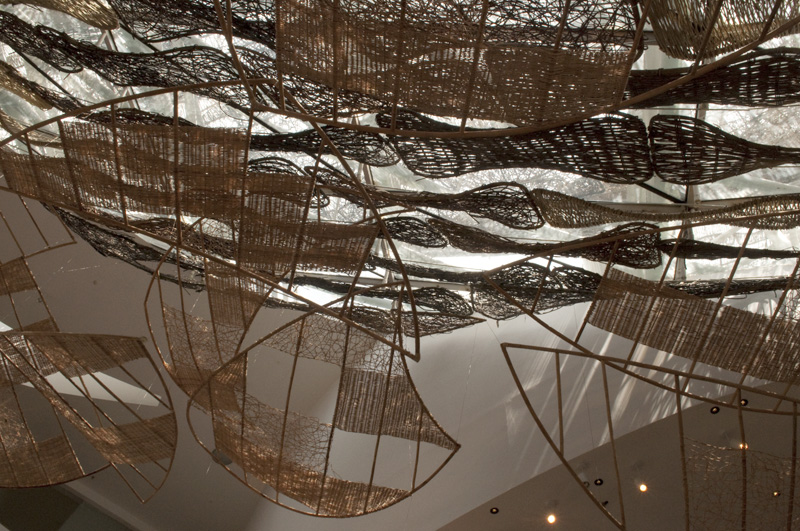
As I briefly mentioned in my last post about Labor Day here in China, I had last Friday off in honor of the holiday. Since traveling in China during national holidays seems to more of a lesson futility due to the large crowds of tourists everywhere, I decided to stay in Beijing and visit some places I wanted to see before I leave. Included on that list, was the newly-reopened Chinese National Museum (中国国家博物馆).
After undergoing over three years of renovations, the National Museum recently re-opened after years of arguing and revisions. Historically, the current site of the National Museum was home to two separate museums, the Museum of Chinese History and the Museum of the Chinese Revolution; they were combined in 2003 to make up the Chinese National Museum. In an effort to boost China's (specifically, Beijing's) international standing, the Chinese government decided it was time to renovate and bring the museum up to par (or at least, what they felt like was up to par).
The original plan was to have the museum completely redone, renovated and opened for the 2008 Beijing Olympics, however due to years of arguing and disagreement over the museum's content and endless revisions on the interior design, was not finished in time. Nor was it finished in time for it's second hoped-for end date, which was supposed to coincide the 60th Anniversary of Communist rule on October 1, 2009. Finally, the National Museum reopened just this past March after years and years of delay.
Since 2008, China's museums have gradually begun waiving their entrance fee, in hopes of attracting more visitors. While I appreciate free museum admission as much as anyone, in the case of the National Museum, this seems to have backfired.
Showing posts with label Europe. Show all posts
Monday, May 2, 2011
Saturday, January 15, 2011
Might as well get comfortable
Recently, there's been a lot of talk about the state of Beijing traffic in the news. According to an oft-quoted study by IBM on traffic in twenty of the world's cities, Beijing and Mexico City tied for last place on their consumer pain index. That is, out of a 100 (a 100 being the worse), Beijing and Mexico City both came in at 99 for the most onerous traffic, based on a variety of factors including gas prices, length of commute and the effects of traffic on day to day decisions.
For those of you unfamiliar with the state of Beijing traffic, China Daily has put together a nice summary of the problems facing Beijing transportation and possible solutions here. (There are pictures too!)
This year, the Beijing city government enacted several ordinances in hopes of curbing Beijing traffic. The most discussed traffic measure aims to curb car sales, which have dramatically increased the last few years. Starting on January 1st of this year, all prospective car buyers must first apply online (or in-person) for a license plate, which are given out on a lottery-based system every month.
Other new traffic ordinances aimed at curbing Beijing's snarling traffic include raising parking rates at all garages, banning non-Beijing registered cars inside the Fifth Ring Road during rush hour and limiting who can drive based on even/odd license plate numbers.
To anyone who lives and Beijing, the news that Beijing traffic is one of the worst in the world hardly comes as a shock. There have been times where I'm pretty sure I've sat (or stood) on a bus for an half-hour(or more) and not moved more than a few yards. Walking is often times faster, if your destination is already within a relatively walkable distance. (Remember, Beijing is a very large, very spread out city.)
As for the Beijing subway, it's great...in theory. However, considering the sheer size of Beijing, the subway stops are relatively few and far between. Not to mention, that with only a few transfer points for each line, certain stations often resemble giant cattle herding centers with hordes of people trying to switch from one line to another, particularly during rush hours and Friday evening. It also takes a while to get from one place to another. For instance, it takes me roughly an hour (including walking time) by subway for me travel from Wangfujing to BNU, which as far as Beijing goes, is pretty centrally located between the 2nd and 3rd Ring Roads.
Now of course, I know that in terms of subway public transportation, I've been a bit spoiled after living in New York City and Paris, both of which have very developed subway systems that have grown and adapted to it's residents needs over many decades. But that doesn't mean Beijing can sit back and wait for time to help solve it's traffic problems.
For those of you unfamiliar with the state of Beijing traffic, China Daily has put together a nice summary of the problems facing Beijing transportation and possible solutions here. (There are pictures too!)
This year, the Beijing city government enacted several ordinances in hopes of curbing Beijing traffic. The most discussed traffic measure aims to curb car sales, which have dramatically increased the last few years. Starting on January 1st of this year, all prospective car buyers must first apply online (or in-person) for a license plate, which are given out on a lottery-based system every month.
Other new traffic ordinances aimed at curbing Beijing's snarling traffic include raising parking rates at all garages, banning non-Beijing registered cars inside the Fifth Ring Road during rush hour and limiting who can drive based on even/odd license plate numbers.
To anyone who lives and Beijing, the news that Beijing traffic is one of the worst in the world hardly comes as a shock. There have been times where I'm pretty sure I've sat (or stood) on a bus for an half-hour(or more) and not moved more than a few yards. Walking is often times faster, if your destination is already within a relatively walkable distance. (Remember, Beijing is a very large, very spread out city.)
As for the Beijing subway, it's great...in theory. However, considering the sheer size of Beijing, the subway stops are relatively few and far between. Not to mention, that with only a few transfer points for each line, certain stations often resemble giant cattle herding centers with hordes of people trying to switch from one line to another, particularly during rush hours and Friday evening. It also takes a while to get from one place to another. For instance, it takes me roughly an hour (including walking time) by subway for me travel from Wangfujing to BNU, which as far as Beijing goes, is pretty centrally located between the 2nd and 3rd Ring Roads.
![]() |
| Picture courtesy of ChinaDaily.com.cn |
Now of course, I know that in terms of subway public transportation, I've been a bit spoiled after living in New York City and Paris, both of which have very developed subway systems that have grown and adapted to it's residents needs over many decades. But that doesn't mean Beijing can sit back and wait for time to help solve it's traffic problems.
Sunday, October 24, 2010
World Expo
Back in August, as a part of our tour package, my parents and I went to the World Expo in Shanghai. The tradition of the World Expo (also known in the past as the World's Fair or Universal Exhibition) dates back to the Great Exhibition in London in 1851, whose main feature was the famed Crystal Palace. Originally, the exhibitions were served as a platform to promote new technology and innovation; however, nowadays the World Expo serves more as a platform for "country-branding." That is to say, the main purpose of the different pavillions at the World Expo now serve as a platform for every country to promote it's national image internationally.
Personally, I wasn't that impressed by the World Expo. Although it's only fair to point out that my opinion was probably at least partially influenced by the fact that it was very hot and humid when we were there. Nonetheless, my parents & I wandered around looking at the architecture of the different pavilions which were each very unique in it's own way. I thought the European countries' pavilions were the most architecturally interesting. You can decide for yourself from the pictures below:
China Pavilion
Inside the Spanish restaurant in the Spain Pavilion
Norway Pavilion
I think architecturally, Norway has the coolest structure.
Germany Pavilion
People-watching is always interesting
Ireland
The shade covers over the benches
Turkey Pavillion
For more information on the history of the World Expo/World's Faire/Universal Exhibiton: http://ilearn-culture.com/world-expo-introduction-and-history/
For more information about the World Expo 2010 at Shanghai: http://en.expo2010.cn/
Labels:
Architecture,
China,
Europe,
Ireland,
Norway,
Photos,
Shanghai,
Spain,
tour,
Turkey,
World Expo
Monday, October 11, 2010
Wuzhen
Located along the Beijing-Hangzhou Grand Canal, Wuzhen is located north of the city of Tongxiang in the Zhejiang province. In the past the canal served as the main artery between the south and Beijing and as a result, Wuzhen became a center of great commercial activity . Nowadays, it's mainly a tourist attraction, often invoking comparisons to Venice. Wuzhen is also known for its indigo and white printed fabrics.
At every doorway, there were small garlic-like bulbs hung. I don't know why. Maybe they're trying to keep the vampires away.
More photos on Angela Photo Musings
Sunday, October 10, 2010
Nujie Mosque
Despite my personal conflicted opinions on religion, religious structures fascinate me. I've been very fortunate to see many different religious structures through my travels but most of them have been of the temple, church or cathedral variety. I've visited very few synagogues and mosques. So upon realizing there is a mosque in Beijing dating back to the 10th century, I was more than eager to go see it for myself.
The Nujie Mosque (also known as the Cow Street Mosque) is located in the Xuanwu district of Beijing, in the southern portion of Beijing. From the exterior, the mosque could pass just another old Chinese temple. But upon on closer inspection, you can see Muslim influences on the decor, including Arabic writing on the beams. Inside the prayer hall is a completely different story. From what I could see (I am not allowed in since I'm not Muslim), the interiors are elaborately decorated in a much more Islamic manner with gold Arabic writing covering the arches.
For those of you who are wondering, Islam has been present in China since the 7th century. Nowadays, there is an estimated 20 million Muslims in China, most of which are concentrated in western China. The largest Muslim minority group in China are the Hui people, who are often easily recognized by their characteristic white hats and beards.
The area surrounding the mosque is also primarily inhabited by Chinese Muslims. There are many Muslim shops and restaurants nearby.
To enter the mosque, unless you are Muslim, you must pay a 10 RMB entrance fee. However for some reason or another (maybe because it was already 4:30 PM), the man who sold me the ticket only charged me 5 RMB. He told me why but because his regional accent was very thick and he spoke quickly, I didn't catch the reason.
The mosque itself isn't very large. It's enclosed from the rest of the city by stone walls, making it a very serene environment. Inside the courtyard, several old men sat in front the prayer hall passing time and chatting. They were very kind and asked me where I was from and I explained in return that I am from the United States but currently studying at BNU.
Since I arrived around 4:30 in the afternoon, I was luckily enough to witness the 4:45 (sunset?) call to prayer (salat). In the past, I have known and lived with Muslims, so I am familiar with their ritual prayer but I never before witnessed an actual call to prayer at a mosque.
Around 4:45, a bell rang announcing it was time to pray. All the older men that had previously been sitting the courtyard took off their shoes, and scurried into the prayer hall while the Imam sang out from the courtyard for people to come pray. After he finished the song, the Imam walked to the front of the prayer hall, he led the men into prayer (the women pray in a separate hall).
Personally, I do not believe in religion, so naturally I do not pray. Despite this, I found observing the men pray very calming and honorable. It's definitely admirable that five times a day, these men are able to put aside whatever other thoughts they may have and focus solely on the act of prayer. I'm not sure if I have the concentration to do that.
In the United States and also in Europe, Isalm has been a big point of contention, especially within the last ten years. In the United States at least, I'm ashamed to say that many people are fearful of Islam and Muslims for no real reason at all. Even trying to build a mosque in the United States seems near impossible. Someday hopefully this will change.
Side note: Religion in China is still a very complicated issue. At BNU, we're often to reminded that it's best to only practice religion in areas designated to practice religion, e.g. a church or a mosque.
The Nujie Mosque (also known as the Cow Street Mosque) is located in the Xuanwu district of Beijing, in the southern portion of Beijing. From the exterior, the mosque could pass just another old Chinese temple. But upon on closer inspection, you can see Muslim influences on the decor, including Arabic writing on the beams. Inside the prayer hall is a completely different story. From what I could see (I am not allowed in since I'm not Muslim), the interiors are elaborately decorated in a much more Islamic manner with gold Arabic writing covering the arches.
For those of you who are wondering, Islam has been present in China since the 7th century. Nowadays, there is an estimated 20 million Muslims in China, most of which are concentrated in western China. The largest Muslim minority group in China are the Hui people, who are often easily recognized by their characteristic white hats and beards.
The area surrounding the mosque is also primarily inhabited by Chinese Muslims. There are many Muslim shops and restaurants nearby.
To enter the mosque, unless you are Muslim, you must pay a 10 RMB entrance fee. However for some reason or another (maybe because it was already 4:30 PM), the man who sold me the ticket only charged me 5 RMB. He told me why but because his regional accent was very thick and he spoke quickly, I didn't catch the reason.
The mosque itself isn't very large. It's enclosed from the rest of the city by stone walls, making it a very serene environment. Inside the courtyard, several old men sat in front the prayer hall passing time and chatting. They were very kind and asked me where I was from and I explained in return that I am from the United States but currently studying at BNU.
Since I arrived around 4:30 in the afternoon, I was luckily enough to witness the 4:45 (sunset?) call to prayer (salat). In the past, I have known and lived with Muslims, so I am familiar with their ritual prayer but I never before witnessed an actual call to prayer at a mosque.
Around 4:45, a bell rang announcing it was time to pray. All the older men that had previously been sitting the courtyard took off their shoes, and scurried into the prayer hall while the Imam sang out from the courtyard for people to come pray. After he finished the song, the Imam walked to the front of the prayer hall, he led the men into prayer (the women pray in a separate hall).
Personally, I do not believe in religion, so naturally I do not pray. Despite this, I found observing the men pray very calming and honorable. It's definitely admirable that five times a day, these men are able to put aside whatever other thoughts they may have and focus solely on the act of prayer. I'm not sure if I have the concentration to do that.
In the United States and also in Europe, Isalm has been a big point of contention, especially within the last ten years. In the United States at least, I'm ashamed to say that many people are fearful of Islam and Muslims for no real reason at all. Even trying to build a mosque in the United States seems near impossible. Someday hopefully this will change.
Old men in the courtyard passing time
Imam singing out the call to prayer
Side note: Religion in China is still a very complicated issue. At BNU, we're often to reminded that it's best to only practice religion in areas designated to practice religion, e.g. a church or a mosque.
Subscribe to:
Posts (Atom)