Showing posts with label Break. Show all posts

Sunday, April 3, 2011

Spring has arrived!

While I still despise winter, the best part of living in places with a 'real' winter (meaning a place with daily below freezing temperatures and snow), is joy of walking outside one day in March/April/May and realizing that spring has finally arrived.

Well, that day arrived sometime last week in Beijing. Instead of the sad, barren, empty trees I'm used to see lining the streets, now there are trees with little specs of green dotting the branches and others have even blossomed overnight.

Since this weekend is a long weekend (I have Monday & Tuesday off for Qingming Festival, the festival during which you traditionally pay your respects to your ancestors), today I went over to Yuyuantan Park to view their famed cherry blossoms. These cherry blossom trees, like the ones in Washington, D.C., were a gift from Japan to China as a offer of peace and friendship. Looking at the blossoms, it undeniable spring is here, and hopefully to stay for a bit.

I hope an equally pretty spring has arrived for all of you as well. And if it hasn't, I hope it comes soon!


Saturday, April 2, 2011

Shikumen Houses

In case I gave you the wrong impression of Shanghai in my last post, Shanghai, despite being a very modern city, does have older parts as well. Aside from the instantly recognizable Bund, another characteristic of Shanghai's by-gone years are it's shikumen houses.

Shikumen houses are a specific style of housing built in the latter half of the 19th century in the foreign settlements to accommodate the influx of refugees from the neighboring Jiangsu and Zhejiang provinces. Literally translated, the term "shikumen" (石库门) means "stone gate," which refers to the stone gates and black doors that were the cornerstone of shikumen architecture.

From the exterior, many of the shikumen houses look very Western in the sense that many incorporate architectural elements more traditionally found in Western cities into the buildings, such as it's namesake stone gates, and verandas. However, behind the gates most of the homes are still laid out in a more traditionally Chinese style that revolves around the central courtyard. In some ways, this mix, at least in my opinion, is the perfect mix of the blended Western and Chinese cultural atheistic that is so very unique to Shanghai.

While we were in Shanghai, Leslie & I spent a decent amount of time wandering around the shikumen houses in the older part of Shanghai. Although the shikumen houses (like the hutongs in Beijing) are constantly under the threat of a wrecking ball, there are still some areas with shikumen houses left, which I strongly believe need to be preserved. While the shikumen houses may not be glamorous or stunning like the Bund, they are also a vital part of Shanghai's heritage that is worth preserving.

Now for some pictures:


For more information on Shanghai's shikumen houses:   http://www.shanghaiholiday.net/shikumen/

Wednesday, March 30, 2011

A funny thing happened on the way to the train station..

[I know it's been a while since I've posted anything about my travels back in January and February. You probably thought I forgot about it. Rest assured, I didn't. I've just been busy. Now back to posts on my winter break travels.]

In the last post about my trip, Leslie & I were in Hangzhou. Our plan was to travel from Hangzhou to Shanghai via the high-speed bullet train that connects the two cities, however we were only semi-successful in completing this goal. However, before we get to that, I have a funny little story about our cab ride from our hostel in Hangzhou to the Hangzhou train station.

As I mentioned, Leslie and I took a cab from the area our hostel was in to the train station. Since our hostel was located off a pedestrian street, we had to first walk out to a larger intersection with cars on it to flag our cab. After a short while, we were able to hail a cab, get in and let the cab driver know that we wanted to go to the train station. The driver, a woman, nods her head and says okay and takes off in the direction of the train station.

After driving a minute or two, we stop at a red light and the driver begins speaking to me. At first, I thought she was perhaps speaking to someone on the phone via a bluetooth or a hands-free device (that's what New York cab drivers are always doing), however after a split second I realize she's talking to me.

She asks me if I would mind and if we weren't pressed for time (we weren't), if she could stop the cab at the convenience store across the intersection so she could run in and use the restroom. She went on explain that at the train station, there's no place for her to pull over and run to the restroom. Since Leslie and I were in no rush, and I understood her urgency, I said it was fine (she also promised to stop the meter so we wouldn't be charged for her bathroom break).

During this entire interaction, the cab driver was incredibly polite and gracious. It just further shows how nice the people of Hangzhou were to use. However, since this entire conversation was in Mandarin, I can only imagine what Leslie first thought when the driver pulled over & ran out of the cab towards the restroom at the convenience store. After I explained it to her though, we had a good laugh.

It's definitely a good anecdote of our trip though.

Now back to the trains. Earlier, I mentioned that Leslie and I wanted to take the high-speed bullet train (the G train0 that allows you to travel a distance of roughly 190 km (118 miles) in a mere 45 minutes. However, since the train ticket agents we purchased the tickets from in Beijing weren't the most helpful nor clued-in of train agents, we ended up on the second-fastest train (the D train) that takes you the same distance in 1 1/2 hours, which is still impressively quick if you think about it.

D Train

Interior of the D train

Regardless, Leslie and I got to Shanghai just fine, despite a mess up about which Shanghai train station we were going to. (The previously mentioned clueless train ticket agents had said we were going to the Shanghai South Train station, but we ended up at the Shanghai Hongqiao Airport train station. Good thing Shanghai's metro system is very thorough.)

For those of you fretting about our missed opportunity, don't worry. Leslie & I made up for it by take the Maglev train, a high-speed electro-magnetic train that goes from Shanghai out to Pudong Airport, when we were leaving Shanghai. Although on our trip to the airport the train speed only climbed up to a "measly" 289 mph (465 km/hr), during it's fastest runs (which are normally in the afternoon), it can go up to 315 mph (507 km/hr).

Maglev Train

Tuesday, March 8, 2011

Quilted pajamas, the newest fashion craze?

As we were making our way to our hostel in Hangzhou for the first time after just arriving, Leslie and I noticed an older woman walking by dressed in a matching quilted pajama set. We thought it was a bit odd to go out dressed like that, but we figured she was probably just running a short errand and she was the only one dressed like that. After all, who are we to judge another person's fashion sense? (Not to mention, I've been guilty of running to the store in sweats in the past as well.)

However, before the day even ended, we realized this 'trend' was not limited to just one person. It was actually pretty common to see people walk around (men, women, old, young and children alike), do their shopping and errands in these quilted pajama sets. It seemed to be quite the trend actually.

I think in total, by the time we left Hangzhou, we counted somewhere between 30 to 40 different people wearing these odd quilted pajama sets. Forty may not sound like a lot, until you realize we were really only in Hangzhou for two days.

Although, I will concede one thing. Despite being a bit odd to where outside of the house, those pajama sets did look warm.  Here are some pictures so you can judge for yourself.


Friday, February 25, 2011

Hangzhou, Re-visited

Stop number two on my winter break travels (stop number three for Leslie) was Hangzhou.

If you're unfamiliar with Hangzhou, it's a city roughly 190 km (about 118 miles) southwest of Shanghai. For many years, Hangzhou's famed West Lake (西湖) made it a popular vacationing spot. Just this year, the New York Times placed Hangzhou in the 33rd spot on their list of "The 41 Places to Go in 2011." It's also now the home to Baidu, China's answer to Google and many of China's other high-tech firms.

As the title of this post suggests, this was my second time to Hangzhou. The first time I was there was with my parents just this past September before my semester started here in Beijing. However, that first time was with a tour so I didn't really get any chance at all to explore on my own, so I was happy to return and get a chance to walk around on my own.

The first we noticed when we landed in Hangzhou (we flew down from Qingdao), was that there was snow on the ground!

Okay, so I realize that doesn't sound so shocking to many of you. But you have to understand that at this point, Beijing & most of the northern China hadn't seen any rain/precipitation since October, much less snow. So when we got to Hangzhou, which was noticeably warmer than Beijing and Qingdao (since it's farther south), we were a surprised to see snow on the ground, even though it wasn't very much.

After we got out of the airport and into the city, Leslie & I hailed a cab to go to our hostel. But since our hostel was in a pedestrian-only area, our taxi driver only drop us off at the gate of the pedestrian-only area.

Since we had directions from the hostel, Leslie & I were not too worried about not being able to find it, however before we could even figure out our bearings, a older man stopped to talk to us. At first, I thought he might be selling something, but after a split second, I realized he was giving directions to our hostel. After speaking to him for a moment though, he offered to show us where it was and no, he was not looking for a tip. He really was just being incredibly kind. Leslie & I were quite shocked by his hospitality.

As it turns out though, hospitality in Hangzhou was not just limited to this one person. Another time, Leslie & I had just pulled out our map to check where we were and another elderly man stopped and told us where we were before we even had a chance to glance at the map. And even one other time, we were walking down a pedestrian street near our hostel and an older woman stopped her conversation with another man just to talk to us & have me explain to Leslie a bit about Hangzhou's history. I have to say, the hospitality of the people in Hangzhou was quite frankly amazing and it made a really big impression on me. I already had a high opinion of Hangzhou to begin with, but the people's attitude to tourists made it even higher.

The next day, Leslie & I set out to explore the star of Hangzhou: West Lake. Since we got to Hangzhou with enough time to explore a bit the day before before sunset, we already had walked a bit around lake closest to our hostel, so in the morning we headed up in a vaguely sketchy looking van-bus up to the northern part to explore the other sections.

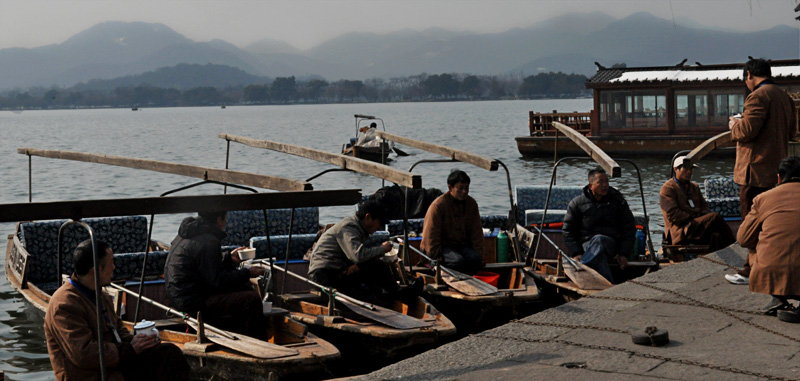
As we walked around the lake, I was really struck by how beautiful the lake really is. The first time, I think I was a bit jaded by all the previous lakes & Chinese gardens we had seen before Hangzhou so West Lake didn't seem that special to me at the time. However, cut to the a few months later after being in Beijing for a while, and the West Lake seemed magnificent in comparison to Beijing (no offense to Beijing).

Probably the most striking thing about the lake was that even though it was the dead of winter and many trees were missing there leaves, there was still a lot of greenery around. In comparison to Qingdao and Beijing, which both looked very grey and almost dead (in terms of plant-life), Hangzhou seemed incredibly green & lush, despite having snow on the ground. The contrast of the snow, the greenery, the bare branches and the occasional already-blooming flower was incredibly beautiful.

Okay, that's enough writing for now. I'll continue writing about Hangzhou in another post. I know all of you just really want to see the pictures so, without further adieu...


Lots more pictures on Angela Photo Musings.

Wednesday, February 23, 2011

The Journey to Laoshan

In all my previous travels in China, I’ve never actually been to an actual mountain in China. I’ve always stuck pretty close to the cities. So when Leslie suggested that we visit a mountain range while she was here, I agreed. We picked Laoshan (), since it is close and easily accessible from Qingdao.

Laoshan (aka Mt. Lao, and Mt. Laoshan), is a large coastal mountain on the Yellow Sea coast. During the height of Taoism, it was the home of nine palaces, eight temples and 72 nunneries. Today, only a few survive, including the oldest and largest of them all, Taiqing Temple. Laoshan is also renowned for it’s spring water, which is supposedly has healing powers and is what gives Tsingtao beer it’s good taste. 

So, after hearing all of that, how could we not go? 

Determined to go visit Laoshan, we asked the staff at our hostel about the best way to get to Laoshan the next day.  However, the look of shock that greeted us in response to our question was shocking to us. Too bad I didn’t have my camera ready to capture their expressions. Our conversation went something like this:

Me: “Excuse me, we want to visit Laoshan tomorrow, what is the best way to go out there?”

Hostel receptionist [look of shock on her face]: “You want to go to Laoshan? Really?”

Me: “Umm…yesss…? Is that possible?”

Hostel receptionist: “It’s going to be very cold if you go to Laoshan.”

Me: “I know. But we’re already here in Qingdao, so we might as well visit it.”

Hostel receptionist [looking perplexed by my insistence]: “Okayyyy…”

I should preface this by saying that at this point, I think the people at the hostel (and possibly the other people of Qingdao as well) already think we’re very bizarre for traveling to their summertime city in the dead of a very frigid winter. In fact, for a while Leslie & I were semi-convinced we were the only two tourists in the entire city. Ha ha. (We were most likely the only two guests at are our hostel though.)

Despite our hostel receptionist’s confusion, she was able to tell us which bus to take out to Laoshan and that night we prepared for a cold hike around Laoshan the next day.

Love locks attached onto a bridge at Laoshan

Now, before we go any further, I have to point out that Leslie & I were basically clueless about what we were going to do when we reached Laoshan and even about how to get there. We were basically completely reliant on the guidance and instructions of others.

 [More of our journey & pictures after the break]

Saturday, February 19, 2011

Tsingdao Brewery

Of course, no trip to Qingdao would be complete without a trip to visit the Tsingtao Brewery, home of what it likes to boast as China's number one imported beer. (Never mind that I'm pretty sure China doesn't import any other beers anyways.)

Now this was not my first trip to a beer brewery (nor my last, I suspect) and I have to say that the brewery tour for Qingdao was a bit lacking. The exhibits and models at Tsingtao were about on par with other breweries I've visited; however, if we're going to be honest here, visiting a brewery is really all about the beer tasting at the end. Leslie & I were very excited about the tasting and were hoping that we could get the chance to taste the other types of beer they produce, since they're harder to find outside of Qingdao. But when we got to the tasting room, we only got two very tiny glasses of their basic beer that you can get anywhere. We were very disappointed.

However, they did have a drunk simulation room at the end of there brewery tour that almost made up for the lack of variety in their tasting room. If you're wondering what exactly a drunk simulation room entails, it's basically a room tilted at at 30 degree angle, which sounds simple enough until you try to walk up the slope. Now that's a challenge. Needless to say, the drunk simulation room proved itself to be very entertaining.

Later that night, to make up for the pathetic beer tasting at the Tsingtao Brewery, Leslie & I conducted our own tasting in our hostel room. We ended up tasting three different types of Tsingtao beer, all of which I had never seen anywhere else besides in Qingdao. Sadly, they were poorly labelled so Leslie & I aren't exactly sure what we were tasting. We do know one was a Tsingtao stout, or as some people know it as, the black Tsingtao beer. As for the other two, all we can say is one had a red label & one had a yellow label. Overall, we really liked the Tsingtao with a red label and didn't really care for the other two. Although, the stout did have a really strong coffee after taste.

Sadly, our pictures of our little beer tasting using coffee mugs are lost on Leslie's stolen memory card/camera. (Stupid pick-pocketers.) So you guys are going to have to use your imagination for that. However, here are some pictures from the brewery tour, including one from the drunk simulation room! Whee!

Apparently, the Tsingtao brewery has the same slogan as
many universities.
Then again, beer & college do go hand-in-hand, at least in the US.


Don't be fooled by the picture.
Objects in the photo are smaller than they appear.


Leslie's drunk! Just kidding.
Welcome to the drunk simulation room, where you laugh so hard
you blur in the photos.

Friday, February 18, 2011

Qingdao

The first stop on my winter break travels was Qingdao, which is located on the southern most tip of the Shandong peninsula in northeast China. Leslie & I took the overnight train from Beijing to Qingdao and stayed in a hostel near the center of the old town. We had booked ourselves into a shared four person dorm; however since it was low season, we ended up having the entire room to ourselves the entire time we were there.

Now for background on Qingdao:

From 1897 to 1922, Qingdao was a German and Japanese concession city and as a result, much of Qingdao's old architecture still retains a German flair. In 1919, protesters in Qingdao headed the May 4th Movement against imperialism in China, with particular regards to the Japanese presence in Qingdao after the end of WWI. More recently, Qingdao hosted the sailing portion of the 2008 Olympics in Beijing and it remains a popular summertime destination because of it's many beaches.

Some thoughts on my time in Qingdao:

  • Qingdao is definitely a summertime city. Many things when Leslie & I were there were closed. Some of them might have been closed down early in anticipation of the Spring Festival/Chinese New Year, but I suspect some of them only do business during the summer catering to tourists. Plus, many of Qingdao's attractions revolve around the beach, which isn't a very hospital able place to visit when mercury is hoovering at freezing every day. 

  • Qingdao is a hilly city. You know you've been in Beijing, which is a very flat city, for too long when your legs are sore after spending a day walking around Qingdao, even though the hills aren't really that steep.

  • If you only stay in the older portion of Qingdao, it seems like a very small town. It's not until I took the bus out to the newer, more recently developed areas that I remembered that it's actually a city with a population of 8.1 million people.

  • Despite claiming to be a big tourist destination, I don't think Qingdao sees many non-Chinese/ non-Asian tourists, which is ironic considering Qingdao used to be a German concession city and hosted a portion of the 2008 Olympics. Where ever we went, people were gawking at Leslie. I think we could count on one hand how many other Westerners we saw during our three days there. When we were at the Qingdao airport waiting for our flight to Hangzhou, a young Chinese woman actually exclaimed very loudly, "There's a foreigner here!" I don't think she expected me to be able to understand what she said.

  • At least in the older part of the city, Qingdao has really maintained a German feel in their buildings. While some of the buildings were probably built when Qingdao was still a German concession, I suspect at least some of them were built later to mimic the more European styles of architecture.

  • In the newer parts of Qingdao, it's obvious that Qingdao is still very much a city in transition. As we walked around the city, Leslie & I saw entire city blocks that were fenced off in anticipation of being demolished and rebuilt. There also a lot of signs for the metro system they're currently building.

  • Things in Qingdao get started much later than in Beijing. Leslie & I arrived on the overnight train from Beijing at 8 AM. Coming from Beijing, we didn't think we'd have a problem checking in at our hostel and finding food. But we were wrong. Luckily though, we were able to call the hostel staff and wake someone up to let us check into the hostel. We soon figured out that morning that things in Qingdao didn't really seem to get moving until around 10 AM.

Now for the pictures I know you've all been waiting for...

The Protestant Church


May 4th Monument


St. Michael's Cathedral

  
Zhanqiao Pier

Thursday, February 17, 2011

Long time no see!

Hello dear blog readers,

My sincerest apologies for being MIA since my winter break started. Traveling is exhausting and time really has flown.

My friend Leslie left this morning to return home to the United States after spending a month with me in China/Hong Kong. I'm sure she's thrilled to excited to return home to comforts of home and not having to listen to Mumford & Sons (my latest musical obsession) every morning. Not to mention the fact that squat toilets don't exist in the United States.

As for me, I have a couple more days left in Hong Kong before I return to Beijing on Sunday. While I'm not exactly jumping for joy about returning to Beijing (after all, Beijing & I have a rather rocky relationship), my "loss" is definitely your gain.

Consider this blog officially back from hiatus. Pictures & posts about my travels to follow soon. Your patience (I think) will be rewarded.

Thanks for reading,

Angela

Wednesday, January 19, 2011

And I'm off!

Being the regular blog readers I know you all are, I'm sure you all realize I'm finally now on my winter break. Better late than never, I say.

Two days after my finals, my friend Leslie came to town. This past week, we've been fitting the bitter Beijing cold and wind and visiting Beijing's major sights. And when I say bitter cold...I really do mean bitter cold.

Tomorrow, we're leaving to travel for a total of ten days to Qingdao, Hangzhou and Shanghai. On the 30th, we'll head to Hong Kong, where we'll be spending the Chinese New Year/Spring Festival. I'm excited (as always) to return to Hong Kong to see family and friends again.

Not to mention that Hong Kong is a food lover's paradise and I love food. Plus, Hong Kong's much warmer than Beijing right now.

Since I'll be on the traveling through the 30th of this month, there will most likely be a decrease in blog posts until I reach Hong Kong, at least. I do hope to get some posts up while I'm on the road, but in case I don't, I hope that everyone has a good rest of January!

And for those of you reading in Hong Kong, I hope to see you soon!

If that doesn't look cold to you, you're crazy.
Summer Palace, Beijing

PS. For those of you going through Living-in-Cultural-Limbo-blog withdrawal (which I know is all of you), at least you know when I return, you'll have lots of pictures and things to look forward to. :)

Saturday, January 8, 2011

Return of the Study Bunny

Yep, it's that time again. Finals time. You know what means...


See you on the other side.

(PS. Only 3 more days until break! Finally! Hooray!)

Sunday, October 10, 2010

Nujie Mosque

Despite my personal conflicted opinions on religion, religious structures fascinate me. I've been very fortunate to see many different religious structures through my travels but most of them have been of the temple, church or cathedral variety. I've visited very few synagogues and mosques. So upon realizing there is a mosque in Beijing dating back to the 10th century, I was more than eager to go see it for myself.

The Nujie Mosque (also known as the Cow Street Mosque) is located in the Xuanwu district of Beijing, in the southern portion of Beijing. From the exterior, the mosque could pass just another old Chinese temple. But upon on closer inspection, you can see Muslim influences on the decor, including Arabic writing on the beams. Inside the prayer hall is a completely different story. From what I could see (I am not allowed in since I'm not Muslim), the interiors are elaborately decorated in a much more Islamic manner with gold Arabic writing covering the arches.

For those of you who are wondering, Islam has been present in China since the 7th century. Nowadays, there is an estimated 20 million Muslims in China, most of which are concentrated in western China. The largest Muslim minority group in China are the Hui people, who are often easily recognized by their characteristic white hats and beards.

The area surrounding the mosque is also primarily inhabited by Chinese Muslims. There are many Muslim shops and restaurants nearby.

To enter the mosque, unless you are Muslim, you must pay a 10 RMB entrance fee. However for some reason or another (maybe because it was already 4:30 PM), the man who sold me the ticket only charged me  5 RMB. He told me why but because his regional accent was very thick and he spoke quickly, I didn't catch the reason.

The mosque itself isn't very large. It's enclosed from the rest of the city by stone walls, making it a very serene environment. Inside the courtyard, several old men sat in front the prayer hall passing time and chatting. They were very kind and asked me where I was from and I explained in return that I am from the United States but currently studying at BNU.

Since I arrived around 4:30 in the afternoon, I was luckily enough to witness the 4:45 (sunset?) call to prayer (salat). In the past, I have known and lived with Muslims, so I am familiar with their ritual prayer but I never before witnessed an actual call to prayer at a mosque.

Around 4:45, a bell rang announcing it was time to pray. All the older men that had previously been sitting the courtyard took off their shoes, and scurried into the prayer hall while the Imam sang out from the courtyard for people to come pray. After he finished the song, the Imam walked to the front of the prayer hall, he led the men into prayer (the women pray in a separate hall).

Personally, I do not believe in religion, so naturally I do not pray. Despite this, I found observing the men pray very calming and honorable. It's definitely admirable that five times a day, these men are able to put aside whatever other thoughts they may have and focus solely on the act of prayer. I'm not sure if I have the concentration to do that.

In the United States and also in Europe, Isalm has been a big point of contention, especially within the last ten years. In the United States at least, I'm ashamed to say that many people are fearful of Islam and Muslims for no real reason at all. Even trying to build a mosque in the United States seems near impossible. Someday hopefully this will change.


Old men in the courtyard passing time

Imam singing out the call to prayer

Side note: Religion in China is still a very complicated issue. At BNU, we're often to reminded that it's best to only practice religion in areas designated to practice religion, e.g. a church or a mosque.

Thursday, October 7, 2010

In the US, there's Chinatown...

...in China, there's Russian-town.


On my way to the 798 Space: a mini-adventure

On Tuesday, I set out to check out Beijing's 798 Space, an art district in the outskirts of Beijing. But before I tell you all about 798, I have to tell you about my journey over to 798. Because, as the saying goes, the journey is half the battle.

As I mentioned previously, 798 is located in the outskirts of Beijing, just north of the Fourth Ring Road. Since there isn't a direct way to get out to 798 solely using the subway, I looked on Google Maps for a good bus route(s) to take out there from BNU. Dutifully, Google Maps quickly spit out directions that seemed to coincide with the directions on the 798 website and I, of course, not knowing any better followed them.

But, as I'm sure you've guessed by now, those directions were not correct. According to the directions and map, the stop I was instructed to get off at would place me directly at the entrance to 798. Wrong. Very wrong. You know where I ended up instead? On a paved road that had  a dirt sidewalk on one side and a walled field around it on the other; in other words..it almost looked like the countryside. Definitely not where I wanted to be*.

After a few minutes of deliberation with myself and tentative walking around to make sure I really was in the wrong area, I decided to go ask the receptionist at a business hotel that luckily for me was located at the bust stop I had gotten off at. I have no idea what a business hotel (let alone a nice business hotel) was doing there all the way outside of the city, but nevertheless the receptionist was very kind when I asked her for directions (in Mandarin!).

As it turns out, I had completely overshot the 798 Space. In fact, I was so far that I couldn't even walk to it. I had to take a different bus back the way I came for roughly 10-15 minutes. (Needless to say, there isn't a dirt sidewalk over by 798; it's paved.)

All I have to say is, thanks, Google Maps; you were always so reliable before, but this time, you led me way astray. I don't appreciate that.

Regardless, I did eventually get to 798 after that little detour and it was definitely worth it. Using the abandon East German electronic factories from the 1950's, Bejing's contemporary art community has re-claimed the factories and turned them into various art galleries, cafes and stores. Since the factory workshops are sufficiently large, they are perfect for displaying art and large scale multimedia installations.

In some ways, 798 greatly reminded me of Brooklyn and Oakland/Emeryville, where many old warehouses have been converted into artist work-live lofts, among other uses. The space is also seemed very contained and separate from the bustling city that surrounded it; much like how Brooklyn always seems calmer than Manhattan.

Even the most of the other visitors of 798 seemed like they belonged in Brooklyn or Oakland. They all were young, like me, hip and interested in contemporary art and culture. It's the type of place I know a lot of my friends from home & New York would love.

Overall, it was a great outing for that day and I'll definitely be returning to 798 again (but not that dirt sidewalk place). And I have to say, I'm a proud of myself for figuring out how to go to my original destination, despite having completely misleading directions.

Here are some photos from 798. I should've taken one of the bus stop I got off when I was lost, but I didn't think of it at the time. Sorry!


I'm not convinced the Italian(?) here actually means what it says in English & Chinese, but I like the sentiment. 

 I'm not exactly sure why the Chinese military acts as security here. Maybe 798 lies right outside of Beijing Security's jurisdiction. Either way, this guy doesn't seem to be doing much. 


For more info about the 798 Space: http://www.798space.com/index_en.asp

*Note: For those of you concerned with my safety, rest assured that this detour occurred around noon on a sunny day and despite the country-esque surroundings, there were other people and cars around. I was in no danger whatsoever. 

Friday, October 1, 2010

Happy Chinese National Day!

As I'm sure you figured out from the title of this post, today is Chinese National Day, which honors the founding of the People's Republic of China 61 years ago.

Naturally of course, today is a holiday. But in China, you don't just get one day off in honor of National Day, you get an entire week. Meaning, I do not have class from today (Friday) through next Thursday (7 October).

During this week off, which is sometimes referred to as "The Golden Week," many people travel both domestically and internationally. This year in particular has seen a record number of international trips booked by Chinese people.

However, since the second portion of my visa is still being processed and my passport is currently holed up in some Chinese government building, I'm a hostage of Beijing this week. Not to worry though, there's plenty to see and do here (as long as it doesn't rain).

For those of you wondering if I've actually come here to Beijing to study with this recent rash of holidays, don't you fret. This my last break until January 1st; after this week it's just day after day of intensive Chinese learning (aside from weekends). So while the rest of you (especially those of you in the US) are enjoying your Christmas, Thanksgiving, Veteran's Day and maybe even Columbus Day, think of me, because I'll be in class.

Wednesday, September 22, 2010

Happy Mid-Autumn Festival!

Today is the first day of the Mid-Autumn Festival here in China and as a result, I have three days off from classes (five, if you include Saturday and Sunday too). Hopefully during my time off, I'll be able to blog more and work on some more photos for all of you. As for now, here's a little info on the Mid-Autumn Festival.

The Mid-Autumn Festival occurs annually on the 15th day of the eighth lunar month. Traditionally, people gather with their families during this festival to gaze at the full moon and eat mooncakes. There are many different types of mooncakes depending on where you are living or where your family is from. The most traditional form has a thin skin around a sweet, dense filling usually of lotus or red bean paste. Sometimes there will also be one or two salted egg yolks in the middle. Personally, I like the salted egg yolk with the sweet filling but some people find it strange.


Traditional mooncake

Traditional mooncake with lotus bean paste & salted egg yokes

In Shanghai though, they eat savory mooncakes that have a thin, filo-dough-like outside and savory meat (pork?) filling on the inside. When my parents & I were in Shanghai, we were lucky enough to be purchase some from some famed mooncake-perveyor on Nanjing Lu. Needless to say, they were delicious.

Box of Shanghainese mooncakes
 
Shanghainese mooncake with savory meat filling

For more information about the mid-Autumn Festival: http://www.chinahighlights.com/travelguide/festivals/mid-autumn-festival.htm